
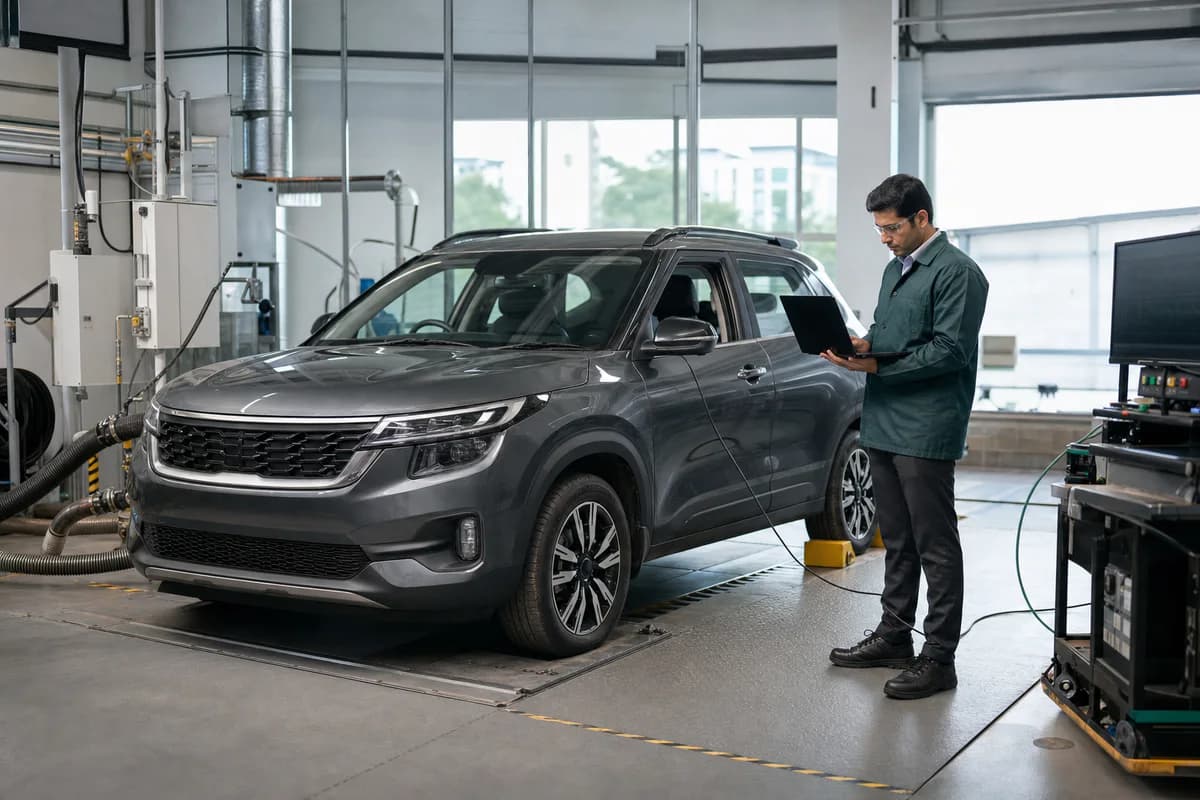
The warranty question has a definite, on-the-record answer. The Society of Indian Automobile Manufacturers has categorically confirmed that OEM warranties will be honoured for vehicles running specification-compliant E20, manufacturers have repeated the commitment individually and in writing, and the service data they cite in support now covers crores of vehicles.
The categorical commitment
SIAM's chief executive director put it plainly at the industry briefing of August 2025: whatever warranty is committed by OEMs will be fully honoured for E20 usage, and insurance claims remain unaffected. The ministry's published record repeats the position in the same terms, SIAM has categorically confirmed warranties will be honoured for vehicles running spec-compliant E20.
This is not a hedged assurance. It is the industry body's stated position, on the record, covering old and new vehicles alike.
Six manufacturers, one position
On 4 July 2026, executives from Maruti Suzuki, Toyota Kirloskar, Hero MotoCorp, Hyundai Motor India, TVS Motor Company and Bajaj Auto addressed the E20 concerns together at a joint briefing in New Delhi. Maruti Suzuki reported that pre-2023, E10-designed cars were tested extensively on E20 with no findings of concern; Hero MotoCorp reported that analysis of its service records found no higher incidence of damage on E20; Hyundai confirmed it had received no substantiated complaints.
Maruti Suzuki also cited tracking data from 1.4 crore E20-operated vehicles showing no evidence of ethanol-induced corrosion.
The service data behind the commitment
The number that anchors the warranty position is a service-network figure: 2.84 crore vehicles serviced by Maruti Suzuki during FY 2025-26, of which more than 1.5 crore were over three years old and therefore not E20-certified at manufacture. No E20-related damage was found across that population.
The ministry's 23 July 2026 statement draws the conclusion directly: manufacturers continue to honour warranty obligations for vehicles using E20 fuel, and manufacturer service data confirm no abnormal corrosion, wear or reduction in vehicle life due to E20.
What manufacturers put in writing
Toyota Kirloskar Motor's customer bulletin of 14 July 2026 states that Toyota will continue to honour warranty claims of all its products as per the warranty terms and conditions offered at the time of sale, and that vehicles sold before 1 April 2023 are engineered with sufficient tolerance to accommodate E20, a finding it notes was validated independently by ARAI.
Honda has stated there is no change in warranty applicability, with all its India-built cars E20 material compatible since 1 January 2009. Hyundai, Tata Motors, Mahindra and Mercedes-Benz have each confirmed warranties will be honoured, per the compatibility record compiled by Autocar India.
What a driver should keep
The commitment is unambiguous, and the paperwork that engages it is simple: keep the fuel receipt and the service history. If a symptom appears, those records let the manufacturer assess the vehicle against its stated warranty terms.